I didn’t mean to invent these cookies. I was trying to salvage a batch of apple cider that was about to turn, and I had a stick of butter I’d browned on a whim for something else entirely. The butter sat there, smelling like toasted nuts and caramel, and the cider sat there, smelling like autumn in a jug. I figured they’d either be amazing or a complete waste of ingredients. Spoiler: they were amazing. But the first batch? Honestly, they spread into one giant, lacy, crispy disc. Delicious, sure, but not a cookie you could pick up without making a mess. It took me three more tries to figure out the right flour-to-liquid balance, and I burned the butter twice in the process—once so badly I had to start over because it tasted bitter and sad. These cookies are the result of all those mistakes. They’re chewy in the middle, crisp at the edges, and taste like someone bottled a perfect October afternoon. I make them every time the leaves start turning, and they never last more than a day.
Why You’ll Love This Recipe
These aren’t your average drop cookies. The brown butter gives them a nutty, almost toffee-like depth that plain butter just can’t touch. And the apple cider? It’s concentrated down into a syrup, so you get real apple flavor without making the dough too wet. It’s a game-changer.
- Quick & Easy: From start to finish, you’re looking at about 30 minutes. Perfect for a last-minute bake sale or a cozy evening treat.
- Simple Ingredients: You probably have most of this in your pantry right now. No weird extracts or hard-to-find flours.
- Perfect for Fall Gatherings: Bring these to a potluck, a Friendsgiving, or just keep them on your counter for when the craving hits. They scream autumn.
- Crowd-Pleaser: Kids love them. Adults love them. I’ve watched people eat three in a row without blinking.
- Unbelievably Delicious: The combo of nutty brown butter, sweet-tart apple cider, and warm cinnamon is next-level comfort food. It’s the kind of cookie that makes you close your eyes after the first bite.
What makes these different from every other apple cider cookie out there is the technique. Most recipes just add cider to the dough, which makes them cakey or flat. By reducing the cider first, you get an intense, concentrated apple flavor that works *with* the brown butter, not against it. This isn’t just another version—it’s the best version I’ve made, and I’ve tested a lot.
These cookies are comfort food reimagined. They’re faster than a pie, more portable than a crumble, and they have the same soul-soothing satisfaction as a warm mug of mulled cider. They’re perfect for impressing guests without stress, or turning a simple Tuesday into something memorable.
What Ingredients You Will Need
This recipe uses simple, wholesome ingredients to deliver bold flavor and satisfying texture without the fuss. Most of these are pantry staples, which makes it easy to whip up a batch whenever the mood strikes.
- Unsalted butter, 1 cup (2 sticks) — You’ll brown this, so don’t skip the unsalted part. Salted butter can foam unpredictably and make it harder to see when the milk solids are toasted.
- Apple cider, 1 cup — Use fresh, unfiltered cider if you can find it. It has more flavor than the filtered stuff. I like to use a local orchard’s cider when it’s in season.
- All-purpose flour, 2 ¼ cups — Spoon and level it. Don’t scoop straight from the bag or you’ll end up with dry, crumbly dough.
- Baking soda, 1 teaspoon — This helps them spread just enough.
- Baking powder, ½ teaspoon — A little lift so they’re not hockey pucks.
- Ground cinnamon, 1 ½ teaspoons — The warm spice that ties everything together.
- Ground nutmeg, ½ teaspoon — Freshly grated is amazing if you have it, but pre-ground works fine.
- Salt, ½ teaspoon — Balances the sweetness and makes the brown butter pop.
- Granulated sugar, ¾ cup — For sweetness and those slightly crispy edges.
- Light brown sugar, ¾ cup, packed — Adds moisture and a deeper, molasses-like flavor that plays well with the brown butter.
- Large egg, 1, at room temperature — A cold egg can seize the brown butter, so let it sit out for 15 minutes.
- Vanilla extract, 1 teaspoon — Use pure, not imitation, for the best flavor.
- Powdered sugar, for rolling (optional) — This gives them a crackly, bakery-style look. Totally optional, but highly recommended.
For the brown butter, I recommend using a light-colored pan so you can see the milk solids turn golden. I’ve burned it in a dark nonstick pan more times than I’d like to admit. For the cider, if you can’t find fresh cider, a good quality store-bought one works, just avoid anything with added spices or preservatives—you want pure apple flavor.
Equipment Needed
You don’t need a lot of fancy gear for these cookies, which is part of the appeal. Here’s what you’ll need:
- Large skillet or saucepan (light-colored is best) — For browning the butter. A light interior helps you see when the milk solids are toasting.
- Small saucepan — For reducing the apple cider.
- Mixing bowls — One large, one medium.
- Whisk — For combining the dry ingredients.
- Rubber spatula or wooden spoon — For mixing the dough.
- Baking sheets — I use two so I can rotate them between racks.
- Parchment paper or silicone baking mats — Non-negotiable. The cookies will stick without them.
- Cookie scoop or tablespoon — For even-sized cookies. A #40 scoop (about 1.5 tablespoons) is perfect.
- Cooling rack — Lets the cookies set up without steaming on the pan.
If you don’t have a cookie scoop, just use two spoons to portion the dough. It won’t be as uniform, but they’ll still taste great. And if you don’t have a cooling rack, you can transfer the cookies to a clean cutting board after a few minutes on the pan. I’ve done it in a pinch, and it works.
Preparation Method
- Brown the butter. Place the 1 cup of unsalted butter in a light-colored skillet over medium heat. Let it melt completely, then swirl the pan occasionally. After about 5-7 minutes, the butter will start to foam and you’ll see golden brown specks forming at the bottom. The smell will shift from buttery to nutty and toasty. Once the specks are amber and the foam subsides, remove it from the heat immediately. Pour it into a heatproof bowl (including all those brown bits—that’s the flavor) and let it cool for 10-15 minutes. Don’t skip this cooling step, or the heat will cook your egg later.
- Reduce the apple cider. While the butter cools, pour the 1 cup of apple cider into a small saucepan. Bring it to a boil over medium-high heat, then reduce to a simmer. Let it bubble away until it’s reduced to about ¼ cup. This takes 12-15 minutes. It should look syrupy and smell intensely of apples. Watch it closely toward the end—it can go from syrupy to burnt in seconds. Pour it into a small bowl and let it cool completely.
- Mix the dry ingredients. In a medium bowl, whisk together the 2 ¼ cups all-purpose flour, 1 teaspoon baking soda, ½ teaspoon baking powder, 1 ½ teaspoons ground cinnamon, ½ teaspoon ground nutmeg, and ½ teaspoon salt. Set aside.
- Combine the wet ingredients. In a large bowl, whisk together the cooled brown butter, ¾ cup granulated sugar, and ¾ cup packed light brown sugar. It should look like wet sand. Add the room temperature egg and 1 teaspoon vanilla extract, and whisk until smooth and glossy. The mixture might look a little separated at first, but keep whisking—it will come together.
- Add the reduced cider. Pour the cooled cider syrup into the wet mixture and whisk until fully combined. The dough will smell incredible at this point. Don’t worry if it looks a little thin; the flour will fix it.
- Combine wet and dry. Add the dry ingredients to the wet mixture in two additions, folding gently with a rubber spatula until just combined. A few streaks of flour are okay. Overmixing will make the cookies tough. The dough will be soft and slightly sticky, but it should hold together when pressed.
- Chill the dough (optional but recommended). Cover the bowl with plastic wrap and refrigerate for at least 30 minutes. This firms up the butter and prevents the cookies from spreading too much. If you’re in a hurry, you can skip this, but they’ll be flatter and less chewy. I always chill mine.
- Preheat the oven. Set your oven to 350°F (175°C). Line two baking sheets with parchment paper or silicone mats.
- Portion the dough. Using a cookie scoop or tablespoon, scoop out rounded tablespoon-sized balls of dough (about 1.5 tablespoons each). If you want that crackly, bakery-style look, roll each ball in powdered sugar before placing it on the baking sheet. Space them about 2 inches apart—they will spread.
- Bake. Bake one sheet at a time on the middle rack for 10-12 minutes. The edges should be set and golden, but the centers will look slightly soft and puffed. Don’t overbake! They’ll continue to set on the hot pan. For a chewier cookie, pull them at 10 minutes. For a crisper edge, go to 12.
- Cool. Let the cookies rest on the baking sheet for 5 minutes. This is crucial—they’re too fragile to move right away. After 5 minutes, transfer them to a cooling rack to cool completely. Or, you know, eat one warm. I won’t judge.
Cooking Tips & Techniques
The first time I made these, I didn’t cool the brown butter long enough. The egg basically scrambled into the warm butter, and I ended up with lumpy, greasy dough. Not my finest moment. So let that butter cool until it’s just warm to the touch—think bathwater temperature, not hot tea.
Another mistake I made was not watching the cider closely enough. I walked away to answer a text, and by the time I came back, the syrup had turned into a sticky, dark, burnt mess. It smelled like a campfire, but not in a good way. Set a timer. Stir it occasionally. The cider will go from syrupy to scorched very quickly in the last minute.
For the most consistent cookies, weigh your flour if you have a kitchen scale. 2 ¼ cups of all-purpose flour is about 280 grams. If you don’t have a scale, use the spoon-and-level method: fluff the flour with a fork, spoon it into your measuring cup, and level it off with a knife. Scooping directly from the bag can add up to 30 extra grams of flour, which makes the cookies dry and cakey.
If you’re baking both sheets at once, rotate them halfway through (swap top and bottom racks, and turn them front to back). My oven runs hot in the back, so I’ve learned to check the cookies at the 8-minute mark just to be safe.
And here’s a pro tip: if you want your cookies to look perfectly round, use a round cookie cutter or a glass to gently scoot the edges into a circle as soon as they come out of the oven. I do this while they’re still on the pan, about 1 minute after baking. It gives them that bakery-perfect look without any extra effort.
Variations & Adaptations
These cookies are pretty forgiving, so feel free to play around. Here are a few ways I’ve adapted them:
- Gluten-Free Version: Substitute the all-purpose flour with a 1:1 gluten-free baking flour blend. I’ve used King Arthur’s Measure for Measure blend, and the cookies came out slightly more tender but still delicious. Add an extra tablespoon of flour if the dough feels too sticky.
- Vegan Version: Swap the butter with vegan butter (I like Miyoko’s or Earth Balance) and use a flax egg (1 tablespoon ground flaxseed + 3 tablespoons water, let sit for 5 minutes). The brown butter flavor won’t be as deep, but it’s still good. Use a vegan-friendly powdered sugar for rolling.
- Add-Ins: Fold in ½ cup of toasted chopped pecans or walnuts for crunch. Or add ½ cup of white chocolate chips for a sweeter, creamier bite. I’ve also done a version with dried cranberries and a pinch of orange zest, which was surprisingly good.
- Spice It Up: Add ¼ teaspoon of ground ginger or cloves along with the cinnamon and nutmeg. It gives the cookies a chai-like warmth that’s perfect for winter.
- Apple Cider Glaze: Whisk together 1 cup of powdered sugar with 2 tablespoons of the reduced cider (or regular cider if you’ve used it all) and a splash of vanilla. Drizzle over the cooled cookies for an extra layer of apple flavor.
I once tried making these with pear cider instead of apple. It was… fine. The flavor was milder and a little floral, but it lacked the tartness that makes the apple version so good. Stick with apple cider for the best results.
Serving & Storage Suggestions
These cookies are best served slightly warm, when the edges are still a little crisp and the center is soft and chewy. If you’ve made them ahead, pop them in a 300°F oven for 3-4 minutes to revive that texture. Microwaving works in a pinch (10-15 seconds), but they won’t be as crisp.
They’re wonderful on their own, but they also pair beautifully with a hot mug of pumpkin spice syrup stirred into coffee or tea. For a dessert spread, serve them alongside a brown sugar pumpkin coffee cake for a full fall-themed table. They also make a great addition to a cookie platter with pumpkin cream cheese muffins for a bake sale or holiday gathering.
To store, place the cooled cookies in an airtight container at room temperature. They’ll stay fresh for up to 4 days. Layer them with parchment paper if you’re stacking them, so they don’t stick together. The texture actually improves after a day—the flavors meld and the cookies become even chewier.
You can freeze the baked cookies for up to 3 months. Wrap them individually in plastic wrap, then place them in a freezer-safe bag. Thaw at room temperature for about 30 minutes, then warm them in the oven as described above. I’ve also frozen the unbaked dough: scoop it into balls, freeze them on a baking sheet until solid, then transfer to a freezer bag. Bake directly from frozen, adding 2-3 minutes to the baking time. This is my secret for having fresh cookies on demand.
Nutritional Information & Benefits
Here’s the estimated nutritional breakdown per cookie (based on 24 cookies):
| Nutrient | Amount |
|---|---|
| Calories | 175 |
| Total Fat | 8g |
| Saturated Fat | 5g |
| Cholesterol | 25mg |
| Sodium | 95mg |
| Total Carbohydrates | 24g |
| Dietary Fiber | 1g |
| Sugars | 14g |
| Protein | 2g |
These cookies aren’t health food, but they do have a few redeeming qualities. The apple cider provides a small amount of vitamin C and antioxidants, and the cinnamon has anti-inflammatory properties. The brown butter, while indulgent, adds a rich flavor that lets you use less sugar than some other cookie recipes. If you’re watching your sugar intake, you can reduce the granulated sugar to ½ cup without ruining the texture, though they won’t be as sweet.
For dietary considerations: these cookies contain gluten, dairy, and eggs. They are not suitable for vegans (without the substitutions listed above) or those with celiac disease (without the gluten-free flour swap).
I personally love that these cookies feel like a treat, but they don’t leave me feeling overly heavy or sluggish. One or two with a cup of tea is the perfect afternoon pick-me-up.
Conclusion
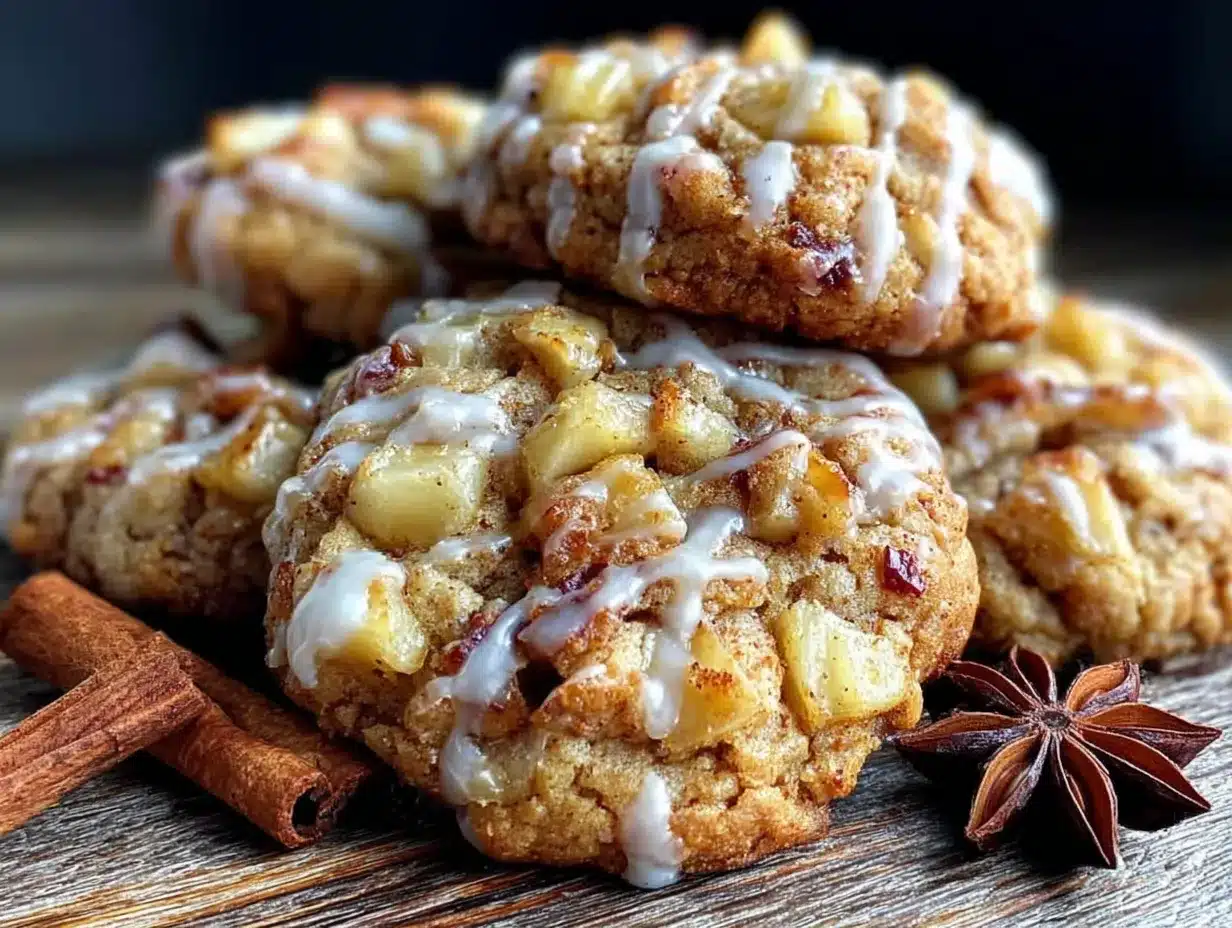
These Perfect Brown Butter Apple Cider Cookies are everything I want in a fall dessert: warm, spiced, chewy, and deeply comforting. They came from a happy accident and a few burned batches, but the final recipe is one I’m genuinely proud of. The brown butter adds a nutty richness, the reduced cider gives you real apple flavor, and the cinnamon and nutmeg make them taste like autumn in cookie form.
I hope you give these a try, and I hope you make them your own. Maybe you’ll add white chocolate chips, or a drizzle of glaze, or maybe you’ll eat them plain straight off the cooling rack. However you do it, I’d love to hear about it. Leave a comment below and let me know how they turned out—did you make any tweaks? Did they disappear as fast as mine always do? Share a photo on social media and tag me so I can see your baking adventures. Happy fall baking, friends!
Frequently Asked Questions
Can I use apple juice instead of apple cider?
Technically yes, but the flavor will be much milder and sweeter. Apple cider has a tangy, unfiltered quality that apple juice lacks. If you’re in a pinch, use apple juice and add a squeeze of lemon juice to mimic that tartness.
Why did my cookies spread too much?
This usually happens for one of three reasons: the butter was too warm when you mixed the dough, the dough wasn’t chilled long enough, or you used too much sugar. Make sure your brown butter is cooled to room temperature, and don’t skip the chilling step. If your kitchen is warm, chill the dough for a full hour.
Can I make these cookies ahead of time?
Absolutely. You can make the dough up to 3 days in advance and keep it covered in the fridge. You can also freeze the baked cookies or the unbaked dough (see the storage section above for details). I often make a double batch and freeze half for later.
My cookies came out cakey, not chewy. What went wrong?
Cakey cookies usually mean too much flour or too much leavening. Make sure you’re measuring your flour correctly (spoon and level, don’t scoop). Also, check that your baking soda and baking powder aren’t expired—old leavening agents can lose their potency and affect texture.
Do I have to reduce the apple cider? Can I just add it straight?
You can, but the cookies won’t be as flavorful, and the extra liquid will make the dough too wet and sticky. Reducing the cider concentrates the apple flavor and removes excess water, so the cookies bake up with a better texture. It’s a small extra step that makes a big difference.
Pin This Recipe!
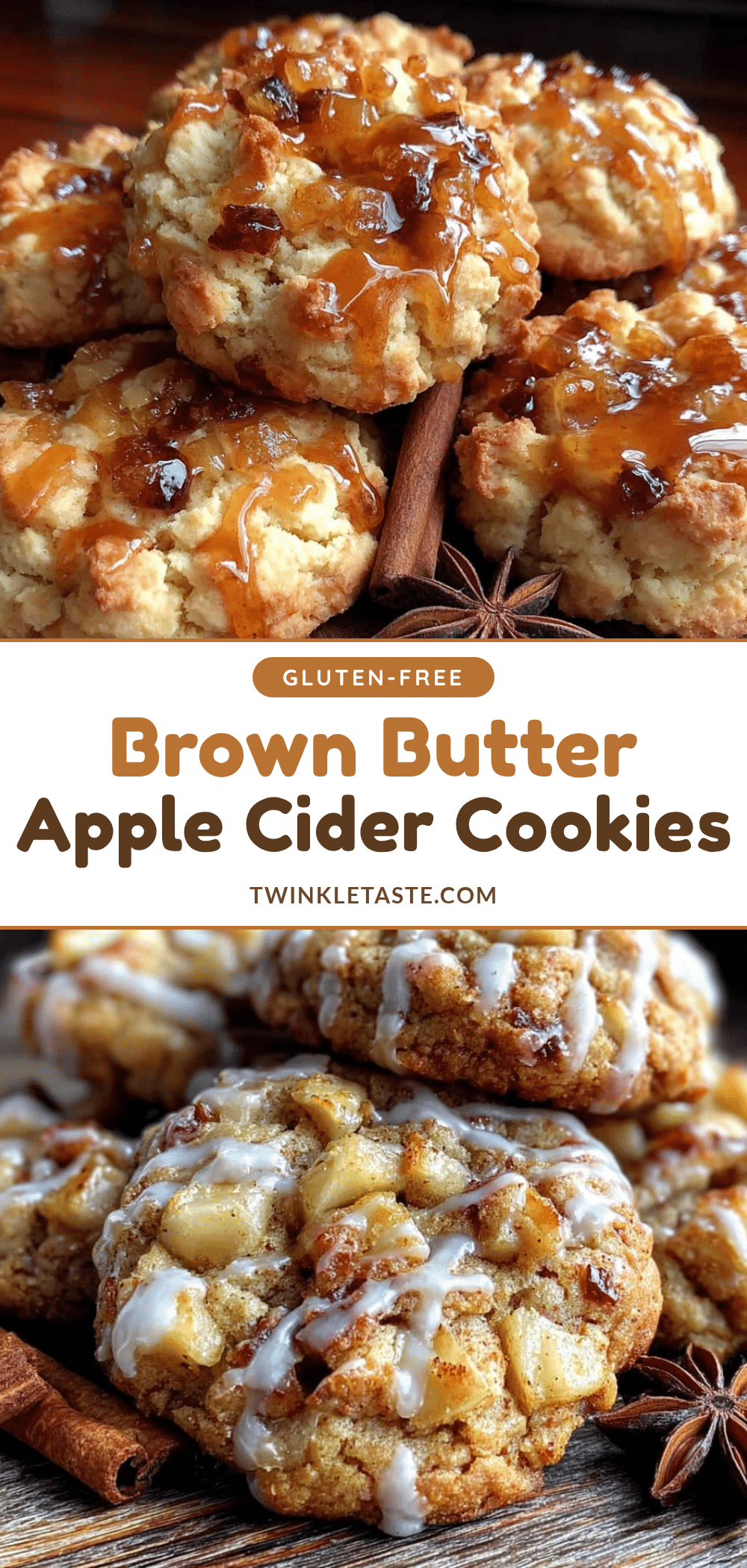
Perfect Brown Butter Apple Cider Cookies: Easy Fall Recipe
These chewy, crisp-edged cookies combine nutty brown butter with concentrated apple cider syrup for an intensely flavorful fall treat. Ready in about 30 minutes, they’re perfect for bake sales, potlucks, or cozy evenings.
- Prep Time: 15 minutes
- Cook Time: 12 minutes
- Total Time: 30 minutes (plus optional 30 minutes chilling)
- Yield: 24 cookies 1x
- Category: Dessert
- Cuisine: American
Ingredients
- 1 cup (2 sticks) unsalted butter
- 1 cup apple cider (unfiltered preferred)
- 2 ¼ cups all-purpose flour
- 1 teaspoon baking soda
- ½ teaspoon baking powder
- 1 ½ teaspoons ground cinnamon
- ½ teaspoon ground nutmeg
- ½ teaspoon salt
- ¾ cup granulated sugar
- ¾ cup packed light brown sugar
- 1 large egg, at room temperature
- 1 teaspoon pure vanilla extract
- Powdered sugar, for rolling (optional)
Instructions
- Brown the butter: Place 1 cup unsalted butter in a light-colored skillet over medium heat. Melt completely, swirling occasionally. After 5-7 minutes, butter will foam and golden brown specks will form. Remove from heat immediately when specks are amber and smell nutty. Pour into a heatproof bowl (including brown bits) and cool for 10-15 minutes.
- Reduce the apple cider: While butter cools, pour 1 cup apple cider into a small saucepan. Bring to a boil over medium-high heat, then reduce to a simmer. Cook until reduced to about ¼ cup (12-15 minutes), watching closely to avoid burning. Pour into a small bowl and cool completely.
- Mix dry ingredients: In a medium bowl, whisk together 2 ¼ cups all-purpose flour, 1 teaspoon baking soda, ½ teaspoon baking powder, 1 ½ teaspoons ground cinnamon, ½ teaspoon ground nutmeg, and ½ teaspoon salt. Set aside.
- Combine wet ingredients: In a large bowl, whisk together cooled brown butter, ¾ cup granulated sugar, and ¾ cup packed light brown sugar until it looks like wet sand. Add room temperature egg and 1 teaspoon vanilla extract, whisk until smooth and glossy.
- Add reduced cider: Pour cooled cider syrup into wet mixture and whisk until fully combined.
- Combine wet and dry: Add dry ingredients to wet mixture in two additions, folding gently with a rubber spatula until just combined (a few streaks of flour are okay). Dough will be soft and slightly sticky.
- Chill dough (optional but recommended): Cover bowl with plastic wrap and refrigerate for at least 30 minutes.
- Preheat oven to 350°F (175°C). Line two baking sheets with parchment paper or silicone mats.
- Portion dough: Using a cookie scoop or tablespoon, scoop rounded tablespoon-sized balls (about 1.5 tablespoons each). Optionally roll each ball in powdered sugar. Space 2 inches apart on baking sheets.
- Bake one sheet at a time on middle rack for 10-12 minutes. Edges should be set and golden, centers slightly soft and puffed. Do not overbake.
- Cool: Let cookies rest on baking sheet for 5 minutes, then transfer to a cooling rack to cool completely.
Notes
Cool brown butter to bathwater temperature before adding egg to prevent scrambling. Watch cider closely during reduction—it can burn quickly in the last minute. For consistent results, weigh flour (280g) or use spoon-and-level method. For perfectly round cookies, use a round cutter or glass to scoot edges into shape 1 minute after baking. Store in airtight container at room temperature for up to 4 days. Freeze baked cookies for up to 3 months or unbaked dough balls for fresh cookies on demand.
Nutrition
- Serving Size: 1 cookie
- Calories: 175
- Sugar: 14
- Sodium: 95
- Fat: 8
- Saturated Fat: 5
- Carbohydrates: 24
- Fiber: 1
- Protein: 2
Keywords: brown butter cookies, apple cider cookies, fall cookies, easy cookie recipe, chewy cookies, autumn dessert