I grabbed the wrong bottle of wine. That’s where this whole thing started. I was standing in my kitchen on a gray Tuesday afternoon, already annoyed that I’d forgotten to pull the beef out of the freezer the night before. The plan was simple—throw together a quick stovetop stew, the kind my grandmother used to make in that dented Dutch oven she refused to replace. But the beef was still half-frozen, the celery was looking sad, and I was running out of patience.
So I did what any reasonable person would do when things go sideways. I abandoned the plan entirely and grabbed my slow cooker. Then I reached for the open bottle of red wine on the counter—a bold Cabernet I’d been sipping while chopping vegetables—and poured way more than the original recipe called for. I mean, a lot more. Like, “is this stew or soup?” more. I figured I’d ruined it. The slow cooker hummed away for six hours while I tried not to think about the wasted ingredients.
When I lifted that lid, the smell hit me first. Rich, deep, almost sweet. The broth had turned this incredible mahogany color, and the beef was so tender it literally fell apart when I poked it with a fork. I stood there with the spoon halfway to my mouth, honestly not sure what to expect. That first bite? Let me tell you—it was one of those moments where you just stop and stare at the pot. The wine hadn’t overwhelmed anything. It had done the opposite. It made everything taste more like itself.
Maybe you’ve had one of those kitchen accidents that turns into your most-requested recipe. That’s this stew. It’s the one my neighbor knocks on the door for. It’s the one I make when I need to feel like I’ve got something right. And honestly, I almost threw it out before I even tasted it.
Why You’ll Love This Recipe
This isn’t just another beef stew recipe you’ll pin and forget about. I’ve tested this thing at least a dozen times, tweaking the wine amount, the cook time, the vegetable size. What I landed on is the version that works every single time, even on days when you’re distracted or running late. Here’s why it’s worth your Sunday afternoon.
- Minimal Hands-On Time : About 15 minutes of prep, then the slow cooker does the heavy lifting. You can walk away and live your life.
- Simple Ingredients : Everything on the list is available at a standard grocery store. No chasing down specialty items or obscure spices.
- Perfect for Meal Prep : This stew actually gets better after a day in the fridge. Make it Sunday, eat it all week.
- Crowd-Pleaser : I’ve served this to picky kids, vegetarian friends who made an exception, and my dad who “doesn’t like slow cooker food.” Empty bowls all around.
- Deep, Complex Flavor : The red wine doesn’t just add alcohol—it adds layers. You get this subtle sweetness, this richness that makes the broth taste like it simmered for hours (because it did).
What makes this recipe different from every other beef stew out there is the wine-to-broth ratio and the way I handle the beef before it goes in. Most recipes tell you to skip browning the meat to save time. Don’t. That five-minute step creates a flavor base you can’t get any other way. The wine deglazes those browned bits from the pan, and that liquid carries all that savory goodness into the slow cooker.
This is the kind of stew that makes you close your eyes after the first bite. It’s comfort food that feels a little fancy but doesn’t require any actual skill. And for those of us trying to eat well without giving up flavor? It’s packed with protein and vegetables, uses olive oil instead of butter, and fills you up without weighing you down.
What Ingredients You Will Need
This recipe uses simple, wholesome ingredients that come together to create something far greater than the sum of their parts. Most of these are pantry staples or easy to find at any grocery store.
For the Stew Base
- Beef chuck, 2 pounds, cut into 1.5-inch cubes (look for well-marbled pieces—they get tender as they cook)
- All-purpose flour, 3 tablespoons (for coating the beef before browning)
- Olive oil, 2 tablespoons (use a good quality one for browning)
- Yellow onion, 1 large, diced (about 1.5 cups)
- Garlic cloves, 4, minced (fresh only—don’t use jarred here)
- Tomato paste, 2 tablespoons (I prefer the tube over the can; it keeps in the fridge for weeks)
For the Liquid and Seasoning
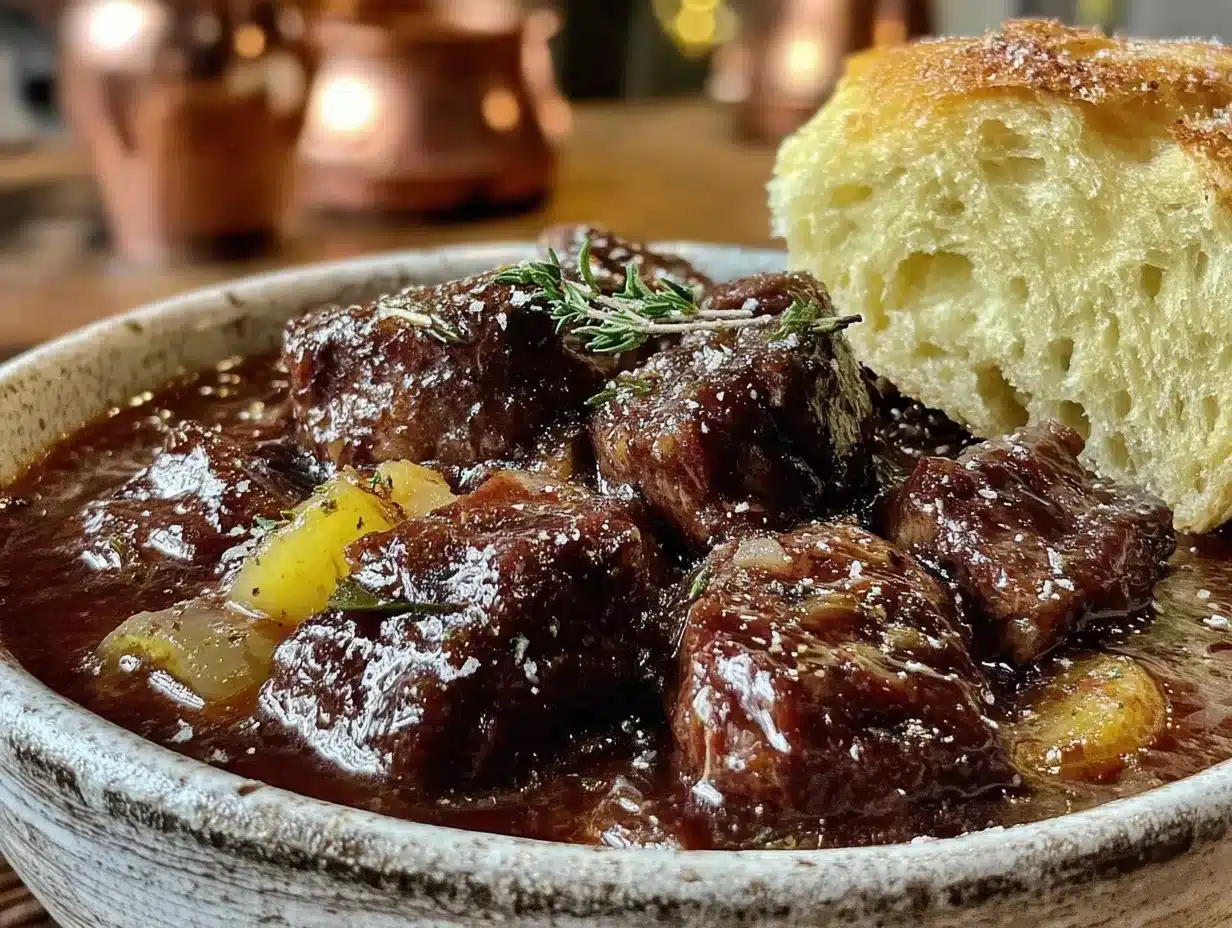
- Dry red wine, 1.5 cups (Cabernet Sauvignon or Merlot work best; never cook with wine you wouldn’t drink)
- Beef broth, 2 cups (low-sodium so you control the salt)
- Worcestershire sauce, 1 tablespoon (adds that umami depth)
- Bay leaves, 2 (remove before serving)
- Fresh thyme sprigs, 4 (or 1 teaspoon dried)
- Salt, 1.5 teaspoons (adjust to taste)
- Black pepper, 1 teaspoon, freshly ground
For the Vegetables
- Carrots, 3 large, peeled and cut into 1-inch chunks
- Celery stalks, 3, sliced into 1/2-inch pieces
- Yukon Gold potatoes, 1 pound, cut into 1-inch cubes (they hold their shape better than Russets)
- Frozen peas, 1 cup (add them at the end so they stay bright green)
A few notes on ingredient choices. I use beef chuck because it has enough fat to stay moist during the long cook time. Leaner cuts like round or sirloin will dry out and turn tough. For the wine, I’ve tested this with a $8 bottle and a $25 bottle—honestly, the $8 one worked fine. Just pick something dry and full-bodied. If you only have white wine or no wine at all, you can substitute with additional beef broth plus a tablespoon of balsamic vinegar for acidity.
For a gluten-free version, swap the all-purpose flour with a 1:1 gluten-free blend or use cornstarch slurry at the end to thicken. And if you’re watching your sodium, look for no-salt-added broth and cut the added salt in half—you can always adjust at the end.
Equipment Needed
You don’t need a fancy kitchen to pull this off. Here’s what you’ll actually use.
- Slow cooker, 6-quart or larger (I use a Cuisinart model I found on sale—nothing fancy)
- Large skillet or Dutch oven (for browning the beef—don’t skip this even if you’re tempted)
- Cutting board and sharp knife (a dull knife makes chopping vegetables miserable)
- Measuring cups and spoons
- Wooden spoon or spatula (for scraping up those browned bits)
- Tongs (for turning the beef while browning)
- Mixing bowl (for tossing beef with flour)
If you don’t have a slow cooker, you can use a large Dutch oven and cook this in the oven at 325°F for about 3 hours, or simmer it on the stovetop on low for 2.5 hours. I’ve done all three methods, and the slow cooker gives the most consistent results with the least effort.
One tip on slow cookers—if yours runs hot (some older models do), check the stew at the 5-hour mark instead of 6. Nothing worse than overcooked beef that turns stringy.
Preparation Method
Take your time with the first few steps. They make all the difference.
- Pat the beef dry with paper towels. This is non-negotiable—wet beef won’t brown properly. Toss the cubes in a bowl with the flour, 1 teaspoon salt, and 1/2 teaspoon pepper until evenly coated.
- Heat the olive oil in a large skillet over medium-high heat until it shimmers. Working in batches (don’t crowd the pan!), add the beef cubes in a single layer. Let them sit undisturbed for 3-4 minutes until a deep brown crust forms. Flip and repeat on all sides. This should take about 8-10 minutes total per batch. Transfer browned beef to the slow cooker.
- Reduce heat to medium and add the diced onion to the same skillet. Cook for 3-4 minutes, scraping up the browned bits from the bottom of the pan. Add the minced garlic and tomato paste, stirring constantly for 1 minute until fragrant and the paste darkens slightly.
- Pour in the red wine slowly, stirring to release any remaining stuck-on bits. Let it simmer for 2-3 minutes until reduced by about half. This cooks off the alcohol and concentrates the flavor. Pour the entire mixture over the beef in the slow cooker.
- Add the beef broth, Worcestershire sauce, bay leaves, and thyme sprigs to the slow cooker. Stir gently to combine. The liquid should come about halfway up the meat—if it looks low, add a splash more broth.
- Scatter the carrots, celery, and potatoes around the beef. Don’t stir them in too much—you want the vegetables to stay somewhat separate so they don’t turn to mush. Cover and cook on LOW for 6-7 hours or on HIGH for 3-4 hours. Low and slow gives you the most tender results.
- In the last 15 minutes of cooking, stir in the frozen peas. They only need to warm through. Remove the bay leaves and thyme stems (the leaves will have fallen off—that’s fine).
- Taste and adjust seasoning before serving. You’ll likely need an extra pinch of salt and a crack of fresh pepper. The stew should be thick enough to coat the back of a spoon. If it’s too thin, mix 1 tablespoon cornstarch with 2 tablespoons cold water and stir it in, then cook on HIGH for 10 more minutes.
A few sensory cues to watch for. The beef is ready when it shreds easily with a fork—no resistance at all. The carrots should be tender but not falling apart. The broth should look deep reddish-brown, almost like a dark gravy. If it looks thin or pale, it needs more time.
Cooking Tips & Techniques
I’ve made every mistake you can make with this stew, so you don’t have to.
Don’t skip browning the beef. I know it’s tempting to just dump everything in the slow cooker and walk away. I’ve done it. The result is edible, but it’s gray and flat-tasting. That browned crust on the beef creates compounds called Maillard reaction products—fancy science talk for “tastes amazing.” The five extra minutes are worth it.
Watch your wine choice. I once used a sweet red blend because it was on sale, and the stew came out tasting like dessert. Stick with dry reds. If you’re not sure, Cabernet Sauvignon is the safest bet—it’s bold enough to stand up to the beef without being overpowering.
Cut vegetables uniformly. I learned this the hard way when I made a stew with huge potato chunks and tiny carrot pieces. The carrots dissolved while the potatoes were still crunchy. Aim for 1-inch pieces across the board, and you’ll get even cooking.
Layer flavors intentionally. The order matters. Onions first, then garlic and tomato paste, then wine. Each step builds on the last. If you dump everything in at once, you lose that complexity.
Resist the urge to peek. Every time you lift that slow cooker lid, you release heat and add 20-30 minutes to the cooking time. Trust the process. Check it once at the 5-hour mark if you’re worried, but no more than that.
Make it ahead. This is one of those rare recipes that genuinely improves overnight. The flavors meld and deepen, the texture gets even better. If you can, make it a day ahead and reheat gently on the stovetop.
Variations & Adaptations
This stew is forgiving. Here are a few ways to make it your own.
Low-Carb/Keto Version : Skip the potatoes and add extra mushrooms or turnips instead. Use almond flour to coat the beef instead of all-purpose. The broth will be slightly thinner, but the flavor is just as rich.
Dairy-Free : This recipe is naturally dairy-free as written. If you want to add richness at the end, stir in a splash of full-fat coconut milk instead of cream.
Extra Vegetables : I’ve added parsnips, sweet potatoes, and even chopped kale in the last 20 minutes. Mushrooms are a fantastic addition—add them with the onions so they get some color.
Herb Variations : Rosemary pairs beautifully with the red wine. Add a sprig along with the thyme. Or try a teaspoon of dried oregano for a slightly Mediterranean twist.
Spicy Kick : Add a pinch of red pepper flakes along with the garlic, or stir in a diced chipotle pepper in adobo sauce for smoky heat.
Beef Substitutions : You can use boneless short ribs for an even more luxurious version, or cubed stew meat from the store (just make sure it’s chuck, not round). For a lighter option, try it with boneless chicken thighs—reduce cooking time to 4 hours on LOW.
My personal favorite variation? I add a parsnip and a small sweet potato alongside the regular potatoes. The sweetness balances the wine beautifully, and the different textures keep every bite interesting.
Serving & Storage Suggestions
Serve this stew hot, straight from the slow cooker. Ladle it into wide, shallow bowls so you get plenty of broth with each scoop. I like to sprinkle a little fresh parsley on top for color, and sometimes a crack of black pepper right before serving.
For sides, crusty bread is non-negotiable. You need something to soak up that wine-infused broth. A simple green salad with a lemony vinaigrette cuts through the richness nicely. Mashed potatoes are also incredible—serve the stew over them for an extra-decadent meal.
This stew also pairs beautifully with a glass of the same red wine you used to cook with. Full circle moment.
Storage : Let the stew cool completely before transferring to airtight containers. It keeps in the refrigerator for up to 5 days. The flavor actually peaks around day 2 or 3.
Freezing : This freezes beautifully for up to 3 months. Portion it into freezer-safe bags or containers, leaving a little headroom for expansion. Thaw overnight in the refrigerator before reheating.
Reheating : Gently reheat on the stovetop over medium-low heat, stirring occasionally. Add a splash of beef broth or water if it’s thickened too much. You can also microwave individual portions in 30-second bursts, stirring in between.
One thing I’ve noticed—the potatoes absorb more liquid as the stew sits, so leftovers will be thicker than the original. That’s not a bad thing, but you might want to add a little broth when reheating to loosen it up.
Nutritional Information & Benefits
Here’s the approximate nutritional breakdown per serving (based on 6 servings):
| Nutrient | Amount per Serving |
|---|---|
| Calories | 385 |
| Protein | 34g |
| Fat | 14g |
| Carbohydrates | 28g |
| Fiber | 5g |
| Sugar | 8g |
| Sodium | 680mg |
This stew is packed with protein from the beef, which keeps you full and satisfied. The carrots and potatoes provide fiber, vitamin A, and potassium. The red wine adds antioxidants called polyphenols, particularly resveratrol, which has been linked to heart health benefits.
If you’re watching your sodium, use low-sodium broth and cut the added salt in half—you can always adjust at the table. This recipe is naturally dairy-free and can be made gluten-free with a simple flour swap.
From a wellness perspective, this is the kind of meal that feels indulgent but is actually quite balanced. It’s hearty enough to be a standalone dinner, and the vegetable-to-meat ratio is solid. I feel good serving this to my family, and I feel good eating it myself.
Conclusion
This slow cooker beef stew with red wine started as a mistake, but it’s become the recipe I turn to when I need something reliable and deeply satisfying. It’s proof that the best dishes don’t come from perfect execution—they come from being willing to try something different when the original plan falls apart.
The wine adds a richness that you just can’t get from broth alone. The slow cooking turns tough beef into something tender and luxurious. And the best part? You barely have to do anything. Brown the meat, dump everything in, and let the slow cooker work its magic.
I’d love to hear how this turns out for you. Did you try a different wine? Add extra vegetables? Forget to brown the beef and do it anyway? Drop a comment below and let me know. And if you make this for someone you love, send them a bowl—it’s the kind of meal that says “I’ve got you” without needing any words.
Now go grab that bottle of wine and make some memories.
Frequently Asked Questions
Can I make this stew in an Instant Pot or pressure cooker?
Yes. Use the sauté function to brown the beef and cook the onions, then pressure cook on HIGH for 35 minutes with a natural release. Add the peas after releasing the pressure.
What if I don’t have red wine? Can I still make this?
Absolutely. Substitute with an equal amount of beef broth plus 1 tablespoon of balsamic vinegar or red wine vinegar. You’ll lose a little depth, but it will still be delicious.
How do I thicken the stew if it’s too thin?
Mix 1 tablespoon cornstarch with 2 tablespoons cold water until smooth. Stir it into the hot stew and cook on HIGH for 10-15 minutes until thickened. You can also mash a few of the potato chunks against the side of the slow cooker to release their starch.
Can I use frozen beef instead of fresh?
You can, but I don’t recommend it. Frozen beef releases too much water when it cooks, which prevents proper browning. If you’re in a pinch, thaw the beef completely and pat it very dry before flouring and browning.
How long does this stew keep in the refrigerator?
Up to 5 days in an airtight container. The flavor actually improves after a day or two. Reheat gently on the stovetop or in the microwave, adding a splash of broth if needed.
Pin This Recipe!
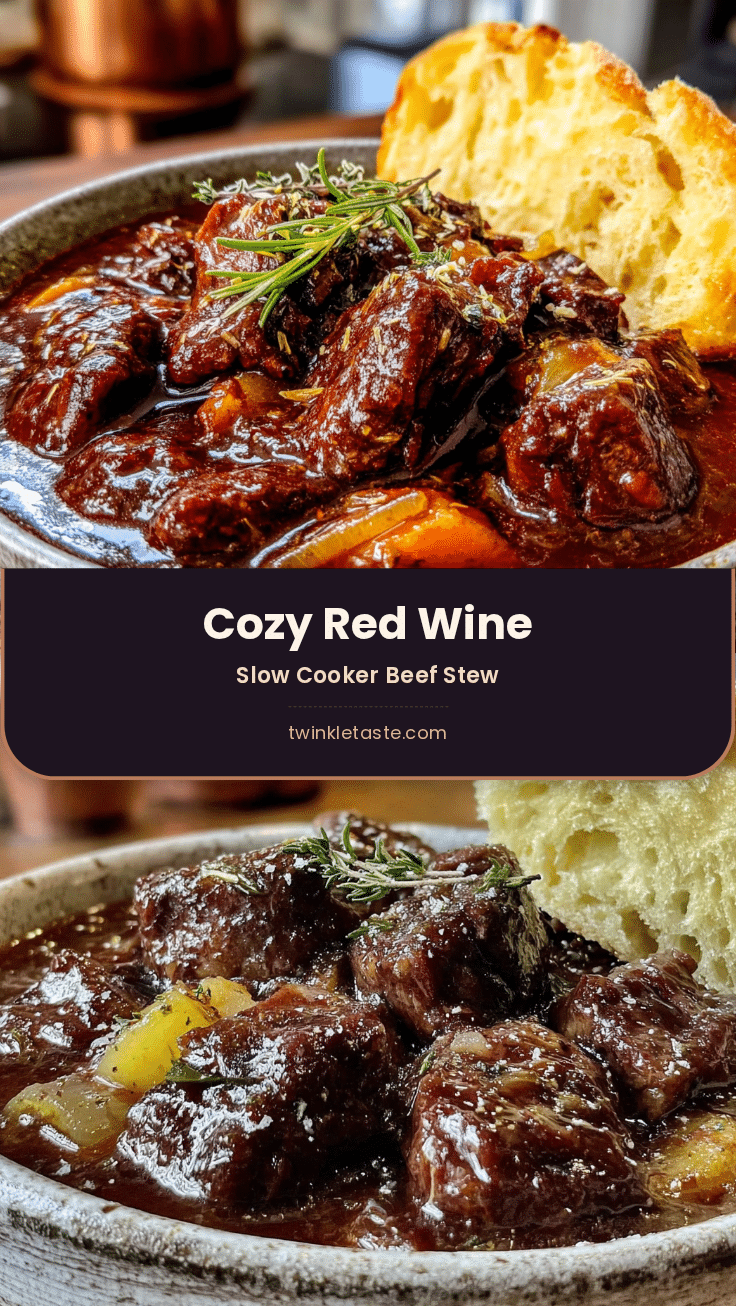
Easy Slow Cooker Beef Stew with Red Wine
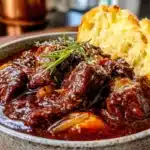
A rich, deeply flavorful beef stew made with red wine, tender beef, and hearty vegetables, all cooked low and slow in a slow cooker. This comforting meal is perfect for busy days and gets even better the next day.
- Prep Time: 15 minutes
- Cook Time: 6 hours
- Total Time: 6 hours 15 minutes
- Yield: 6 servings 1x
- Category: Main Course
- Cuisine: American
Ingredients
- 2 pounds beef chuck, cut into 1.5-inch cubes
- 3 tablespoons all-purpose flour
- 2 tablespoons olive oil
- 1 large yellow onion, diced (about 1.5 cups)
- 4 garlic cloves, minced
- 2 tablespoons tomato paste
- 1.5 cups dry red wine (Cabernet Sauvignon or Merlot)
- 2 cups low-sodium beef broth
- 1 tablespoon Worcestershire sauce
- 2 bay leaves
- 4 fresh thyme sprigs (or 1 teaspoon dried)
- 1.5 teaspoons salt
- 1 teaspoon freshly ground black pepper
- 3 large carrots, peeled and cut into 1-inch chunks
- 3 celery stalks, sliced into 1/2-inch pieces
- 1 pound Yukon Gold potatoes, cut into 1-inch cubes
- 1 cup frozen peas
Instructions
- Pat the beef dry with paper towels. Toss the cubes in a bowl with the flour, 1 teaspoon salt, and 1/2 teaspoon pepper until evenly coated.
- Heat the olive oil in a large skillet over medium-high heat until shimmering. Working in batches, add the beef cubes in a single layer. Let them sit undisturbed for 3-4 minutes until a deep brown crust forms. Flip and repeat on all sides (about 8-10 minutes total per batch). Transfer browned beef to the slow cooker.
- Reduce heat to medium and add the diced onion to the same skillet. Cook for 3-4 minutes, scraping up the browned bits from the bottom of the pan. Add the minced garlic and tomato paste, stirring constantly for 1 minute until fragrant and the paste darkens slightly.
- Pour in the red wine slowly, stirring to release any remaining stuck-on bits. Let it simmer for 2-3 minutes until reduced by about half. Pour the entire mixture over the beef in the slow cooker.
- Add the beef broth, Worcestershire sauce, bay leaves, and thyme sprigs to the slow cooker. Stir gently to combine. The liquid should come about halfway up the meat—if it looks low, add a splash more broth.
- Scatter the carrots, celery, and potatoes around the beef. Don’t stir them in too much—you want the vegetables to stay somewhat separate so they don’t turn to mush. Cover and cook on LOW for 6-7 hours or on HIGH for 3-4 hours.
- In the last 15 minutes of cooking, stir in the frozen peas. They only need to warm through. Remove the bay leaves and thyme stems (the leaves will have fallen off—that’s fine).
- Taste and adjust seasoning before serving. You’ll likely need an extra pinch of salt and a crack of fresh pepper. The stew should be thick enough to coat the back of a spoon. If it’s too thin, mix 1 tablespoon cornstarch with 2 tablespoons cold water and stir it in, then cook on HIGH for 10 more minutes.
Notes
Don’t skip browning the beef—it creates a deep flavor base. Use a dry red wine like Cabernet Sauvignon or Merlot. For a gluten-free version, swap the all-purpose flour with a 1:1 gluten-free blend or use a cornstarch slurry at the end to thicken. The stew improves overnight, so consider making it a day ahead.
Nutrition
- Serving Size: 1 serving
- Calories: 385
- Sugar: 8
- Sodium: 680
- Fat: 14
- Saturated Fat: 4
- Carbohydrates: 28
- Fiber: 5
- Protein: 34
Keywords: slow cooker beef stew, red wine beef stew, easy beef stew, comfort food, slow cooker recipe, beef stew with wine