Last Tuesday, I stopped by my neighbor Rosa’s house to borrow a ladder—mine had mysteriously vanished after a garage sale—and the smell hit me before I even got through the screen door. It wasn’t a fancy dinner party or anything special. She was just standing there in her bare feet, wiping flour off her cheek with the back of her hand, and this golden cake was cooling on the counter. “Oh, that?” she said when I asked, like I’d pointed out a dust bunny. “It’s just lemon cake. My grandmother used to make it.” Just lemon cake. I mean, honestly, I nearly cried. The kitchen smelled like sunshine and someone’s Italian grandmother had bottled happiness. She cut me a slice while I stood there holding the ladder, and that first bite—the olive oil made it impossibly tender, and the honey glaze had this floral sweetness that caught me completely off guard. Rosa shrugged and said it was nothing, but I knew better. Some recipes don’t announce themselves with fanfare. They just show up, make themselves at home, and refuse to leave your memory. Maybe you’ve been there—that moment when something so ordinary turns out to be extraordinary. I’ve made this cake at least a dozen times since that Tuesday afternoon, and every single time, I close my eyes after the first bite. It’s that good.
Why You’ll Love This Recipe
This isn’t just another lemon cake recipe you’ll bookmark and forget. This is the one that gets requested for every birthday, every potluck, every “I just need something that works.” Let me tell you why this Meyer lemon olive oil cake with honey glaze has earned a permanent spot in my baking rotation.
- Incredibly moist without being heavy. The olive oil does something butter just can’t—it keeps this cake tender for days. I’ve had slices on day three that still tasted freshly baked.
- No mixer required. You can whisk this together by hand in about ten minutes. No hauling out the stand mixer, no creaming butter, no fuss.
- Perfect for company. This cake looks like you spent hours on it, but honestly, it’s one of the easiest things you’ll ever bake. Your guests will think you’re a pastry chef.
- That honey glaze. The floral sweetness of the honey paired with the bright, almost floral acidity of Meyer lemons? It’s a combination that stops conversation.
- Meyer lemons make the difference. Regular lemons are great, but Meyer lemons are sweeter, less acidic, and have this almost tangerine-like perfume. They make the cake taste like spring.
I’ve tested this recipe maybe seven times to get it just right. Too much olive oil and the cake gets greasy. Too little and it’s dry. The first time I made it, I forgot the salt entirely—don’t do that, by the way—and it tasted flat. But this version? This is the one. It’s the kind of cake that makes people close their eyes after the first bite, and honestly, that’s the best compliment a baker can get.
What Ingredients You Will Need
This recipe uses simple, mostly pantry-friendly ingredients, but there are a few key players that make it sing. Let’s talk about what you’ll need and why each one matters.
For the Cake:
- 1 ½ cups (190g) all-purpose flour — I use King Arthur Flour for consistent results, but any good all-purpose flour works. Spoon and level your flour; don’t scoop straight from the bag or you’ll end up with a dense cake.
- 1 cup (200g) granulated sugar — Regular white sugar is fine here. The Meyer lemon zest gets rubbed into the sugar to release the oils, so don’t skip that step.
- 3 large eggs, room temperature — Cold eggs can seize up the batter. Leave them on the counter for about 30 minutes, or place them in a bowl of warm water for 5 minutes if you’re in a hurry.
- ½ cup (120ml) good quality extra-virgin olive oil — This is important. Use a mild, fruity olive oil, not something aggressively peppery. I like California Olive Ranch for baking—it’s smooth and doesn’t overpower the lemon. The olive oil is what makes this cake so tender and moist, so don’t substitute with vegetable oil. Trust me on this.
- ½ cup (120ml) whole milk, room temperature — Whole milk gives the best texture, but 2% works in a pinch. Avoid skim milk; the cake needs the fat.
- Zest of 3 Meyer lemons — This is non-negotiable. Meyer lemons are smaller than regular lemons, so you’ll need more. Their zest is fragrant and almost floral. If you can’t find Meyer lemons, use 2 regular lemons plus 1 teaspoon of orange zest.
- ¼ cup (60ml) fresh Meyer lemon juice — About 2-3 lemons, depending on size. Roll them on the counter before juicing to get the most juice out.
- 1 ½ teaspoons baking powder — Check the expiration date on your baking powder. Old baking powder = flat cake.
- ½ teaspoon salt — Fine sea salt or table salt. Don’t skip it; it balances the sweetness and brightens the lemon flavor.
For the Honey Glaze:
- 1 cup (120g) powdered sugar, sifted — Sifting prevents lumps. I learned this the hard way after serving a lumpy-glazed cake to my book club.
- 2 tablespoons honey — Use a mild honey like clover or orange blossom. Strong honey like buckwheat can overpower the delicate lemon flavor.
- 2-3 tablespoons fresh Meyer lemon juice — Start with 2 tablespoons and add more if needed. You want a thick but pourable consistency.
- Pinch of salt — Just a tiny pinch. It makes the glaze taste more complex.
Optional Garnishes:
- Thinly sliced Meyer lemons, candied or fresh
- Fresh thyme or rosemary sprigs
- Flaky sea salt for sprinkling on top
Equipment Needed
You don’t need a fancy kitchen to make this cake, but having the right tools makes everything easier. Here’s what you’ll need:
- 9-inch round cake pan — A springform pan works beautifully here because the cake is delicate. If you use a regular pan, line the bottom with parchment paper.
- Mixing bowls — One large, one medium. Glass or stainless steel is fine.
- Whisk — A good balloon whisk is all you need. No electric mixer required.
- Microplane or fine grater — For zesting the lemons. A box grater works too, but a Microplane gives you finer zest that blends into the sugar better.
- Citrus juicer — A reamer or handheld juicer makes quick work of the lemons. I’ve used a fork in a pinch, but it’s messy.
- Cooling rack — Essential for even cooling. If you don’t have one, you can use the oven rack (just make sure it’s clean).
- Small saucepan — For warming the honey glaze ingredients together, though you can also do this in the microwave.
- Offset spatula — Not required, but it makes spreading the glaze look professional. A butter knife works too.
Budget-friendly tip: If you don’t have a springform pan, just line a regular cake pan with two long strips of parchment paper that hang over the edges. You can lift the cake out easily after it cools.
Preparation Method
Let’s get baking. This recipe comes together in about 15 minutes of active time, plus 40-45 minutes of baking. Here’s how to do it:
- Preheat your oven to 350°F (175°C). Position the rack in the center of the oven. Grease your 9-inch cake pan with butter or olive oil, then line the bottom with a circle of parchment paper. This step is crucial—the cake is tender and will stick to an unlined pan.
- Rub the lemon zest into the sugar. In a large bowl, combine the sugar and Meyer lemon zest. Use your fingertips to rub them together until the sugar is fragrant and slightly damp, about 1 minute. This releases the essential oils from the zest and infuses the entire cake with lemon flavor. Seriously, stop and smell it—it’s incredible.
- Whisk in the wet ingredients. Add the eggs one at a time to the sugar mixture, whisking well after each addition. The batter should look pale and slightly thickened. Pour in the olive oil, milk, and fresh lemon juice, and whisk until smooth. Don’t worry if it looks a little separated at this point; the flour will bring it together.
- Add the dry ingredients. In a separate medium bowl, whisk together the flour, baking powder, and salt. Add the dry ingredients to the wet ingredients in two additions, folding gently with a spatula or whisking just until combined. Do not overmix. A few small lumps are fine. Overmixing develops gluten and makes the cake tough.
- Pour the batter into the prepared pan. Use a spatula to spread it evenly. Give the pan a gentle tap on the counter to release any air bubbles.
- Bake for 40-45 minutes. The cake is done when the top is golden brown, the edges pull away slightly from the pan, and a toothpick inserted into the center comes out clean or with a few moist crumbs. If the top is browning too quickly after 30 minutes, tent loosely with aluminum foil.
- Cool the cake in the pan for 15 minutes. Then run a knife around the edges and invert onto a cooling rack. Remove the parchment paper and let the cake cool completely before glazing. This usually takes about 1 hour. Don’t rush this step—a warm cake will soak up the glaze and turn it into a sticky mess.
- Make the honey glaze. While the cake cools, sift the powdered sugar into a medium bowl. Add the honey, 2 tablespoons of Meyer lemon juice, and a pinch of salt. Whisk until smooth. If the glaze is too thick, add more lemon juice a teaspoon at a time. If it’s too thin, add more powdered sugar. You want it thick enough to coat the back of a spoon but still pourable.
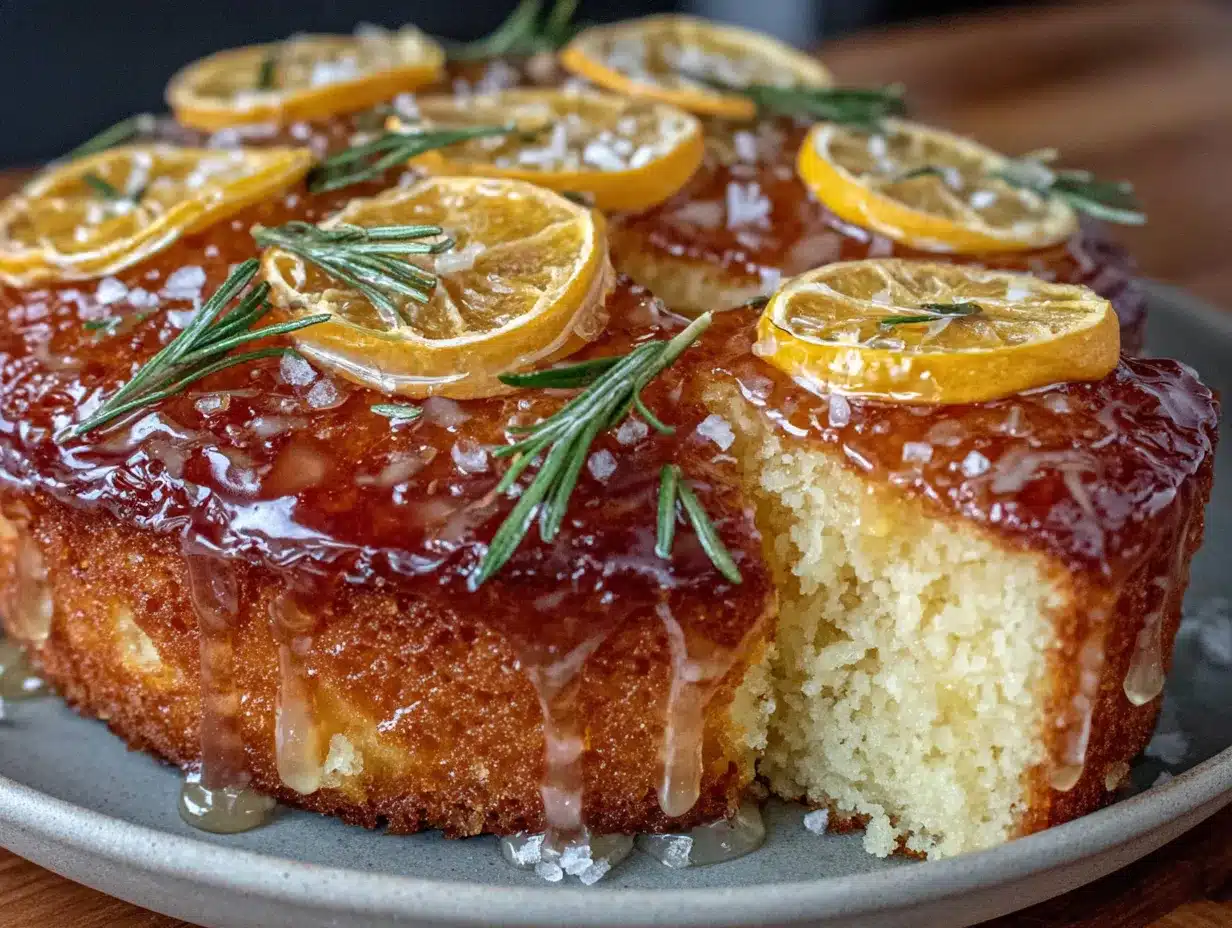
- Glaze the cake. Place the cooled cake on a serving plate or cake stand. Pour the glaze over the center, then use an offset spatula or the back of a spoon to spread it to the edges. Let it drip naturally down the sides. If you’re adding garnishes like candied lemon slices or fresh herbs, do it now before the glaze sets.
- Let the glaze set for about 20 minutes. Then slice and serve. The glaze will firm up slightly but remain soft and glossy.
Pro tip: For the cleanest slices, use a long, sharp knife and wipe it clean between each cut. This cake is tender, and the glaze can drag if you’re not careful.
Cooking Tips & Techniques
I’ve made this cake enough times to know exactly where things can go wrong. Here are the lessons I learned the hard way so you don’t have to.
Don’t skimp on the olive oil quality. The first time I made this, I used the cheap olive oil I usually cook with, and the cake had a bitter, almost metallic aftertaste. Use something you’d actually dip bread in. A mid-range, fruity extra-virgin olive oil makes all the difference. I once used a bottle my friend brought back from California, and that cake was the best I’ve ever made.
Room temperature ingredients matter. I know, I know—every recipe says this, and it feels like a hassle. But cold eggs and cold milk can cause the olive oil to seize up, leaving you with a dense, uneven crumb. Set everything out 30 minutes before you start. Or, if you forgot, place the eggs in a bowl of warm water for 5 minutes and microwave the milk for 10 seconds.
Watch your baking time. Ovens vary wildly. My old oven would bake this cake in exactly 38 minutes. My new one takes 45. Start checking at the 35-minute mark. The cake should be golden and spring back when lightly pressed in the center. Overbaking dries it out, and this cake is all about that moist, tender crumb.
Let the cake cool completely. I once glazed a slightly warm cake because I was impatient, and the glaze melted into a puddle around the base. It still tasted good, but it looked like a disaster. Patience pays off here.
Double the glaze if you’re a glaze person. I always do. I like a thick, generous layer that pools slightly on the plate. The original recipe’s glaze amount is perfect for a thin, elegant coating, but if you want those dramatic drips, go ahead and make 1.5 times the recipe.
Variations & Adaptations
This cake is wonderfully adaptable. Here are some ways I’ve changed it up depending on what I had on hand or who I was serving.
Gluten-free version: Substitute the all-purpose flour with a good 1:1 gluten-free baking flour blend. I’ve used Bob’s Red Mill 1:1 with excellent results. Add 1 teaspoon of xanthan gum if your blend doesn’t already include it. The texture will be slightly more delicate, so handle with care.
Dairy-free version: Swap the whole milk for oat milk or unsweetened almond milk. I’ve also used full-fat coconut milk, which adds a subtle richness that pairs beautifully with the olive oil and lemon. Just make sure your milk alternative has some fat content—watery milks won’t give the same tender crumb.
Regular lemon version: Can’t find Meyer lemons? No problem. Use 2 regular lemons for the zest and ¼ cup of regular lemon juice. Add 1 tablespoon of orange juice to mimic the sweetness of Meyer lemons. It won’t be exactly the same, but it’ll still be delicious.
Herb-infused version: Add 1 tablespoon of finely chopped fresh rosemary or thyme to the batter along with the dry ingredients. The herbal notes play beautifully with the lemon and olive oil. I made this for a spring brunch once, and people couldn’t stop talking about it.
Berry twist: Gently fold 1 cup of fresh blueberries or raspberries into the batter before pouring it into the pan. Toss them in a tablespoon of flour first to prevent them from sinking to the bottom. The burst of tart berries against the sweet honey glaze is incredible.
Lavender honey version: Infuse the honey for the glaze with 1 teaspoon of dried culinary lavender. Warm the honey gently with the lavender, then strain it before making the glaze. It’s floral and dreamy—perfect for a Mother’s Day brunch.
Serving & Storage Suggestions
This cake is a showstopper at any gathering, and how you serve it can make it even more memorable.
Serving temperature: This cake is best at room temperature. If you’ve stored it in the fridge, let it sit out for about 30 minutes before serving. The texture softens and the flavors become more pronounced.
Presentation ideas: Place the cake on a simple white cake stand to let the golden glaze pop. Garnish with thin, candied Meyer lemon slices and a few sprigs of fresh thyme or rosemary. For a dinner party, I like to add a small dollop of lightly sweetened whipped cream or a scoop of vanilla bean ice cream on the side. The contrast of warm cake and cold cream is heaven.
What to serve alongside: This cake pairs beautifully with a cup of Earl Grey tea or a crisp espresso. For brunch, serve it alongside fresh berries and a mimosa. For dessert after a heavy meal, it’s light enough to not weigh anyone down—just a simple slice with a dusting of powdered sugar.
Storage instructions: Store the cake in an airtight container at room temperature for up to 3 days. Do not refrigerate—the fridge dries out the cake and makes the glaze sticky. If you need to store it longer, wrap it tightly in plastic wrap and then foil, and freeze for up to 3 months. Thaw overnight in the refrigerator, then bring to room temperature before serving.
Reheating: If you want that just-baked warmth, microwave individual slices for 10-15 seconds. Or place slices on a baking sheet in a 300°F oven for 5 minutes. The glaze will soften and get slightly glossy again.
Flavor development: Honestly, this cake tastes even better on day two. The lemon and olive oil flavors meld together overnight, and the honey glaze sinks in just a little. If you can resist eating it the day you bake it, you’re a stronger person than me.
Nutritional Information & Benefits
While this cake is definitely a treat, it has some surprising nutritional perks thanks to its key ingredients. Here’s a rough breakdown per slice (based on 10 servings):
| Nutrient | Amount per Slice |
|---|---|
| Calories | ~320 |
| Total Fat | 14g |
| Saturated Fat | 2g |
| Carbohydrates | 46g |
| Sugar | 32g |
| Protein | 4g |
| Fiber | 1g |
Health highlights: Olive oil is rich in heart-healthy monounsaturated fats and antioxidants. Meyer lemons are packed with vitamin C and flavonoids that support immune health. Honey, while still sugar, contains trace amounts of antioxidants and has a lower glycemic index than refined sugar. This cake is also naturally dairy-free if you use a plant-based milk, and it’s lower in saturated fat than traditional butter cakes.
Dietary considerations: This recipe contains gluten, eggs, and dairy (unless modified). For a gluten-free version, see the variations section above. For a vegan version, substitute the eggs with flax eggs (2 tablespoons ground flaxseed mixed with 6 tablespoons water) and use a plant-based milk. The texture will be slightly denser but still delicious.
I’m not a nutritionist, but I love that this cake feels a little less guilty than a traditional butter-laden dessert. It’s the kind of treat you can enjoy without feeling like you need a nap afterward.
Conclusion
This Meyer lemon olive oil cake with honey glaze is the recipe I turn to when I want to impress without stress. It’s simple enough for a Tuesday afternoon, yet elegant enough for a dinner party. The olive oil makes it impossibly tender, the Meyer lemons give it a bright, floral lift, and that honey glaze? It’s the kind of finish that makes people ask for the recipe before they’ve even finished their slice.
I love that this cake doesn’t try too hard. It’s not fussy or complicated. It just shows up, does its thing, and leaves everyone happy. That’s the kind of recipe I want in my back pocket, and I hope it becomes one of yours too.
If you make this cake—and I really hope you do—let me know how it turns out. Leave a comment below, tag me in your photos, tell me if you added your own twist. I love hearing about your baking adventures. And if you serve it at a dinner party and everyone goes quiet after the first bite? That’s the highest compliment there is.
Happy baking, friends. Go make something that smells like sunshine.
Frequently Asked Questions
Can I use regular lemons instead of Meyer lemons?
Absolutely. Use 2 regular lemons for the zest and ¼ cup of regular lemon juice. Add 1 tablespoon of orange juice to balance the acidity. The cake won’t have that same floral sweetness, but it’ll still be delicious.
Why did my cake sink in the middle?
This usually happens for one of three reasons: the oven wasn’t hot enough, the baking powder was old, or the cake was underbaked. Make sure your oven is fully preheated and your baking powder is fresh. Always test with a toothpick before pulling the cake out.
Can I make this cake ahead of time?
Yes! This cake actually tastes better on day two. Bake it a day ahead, let it cool completely, and store it tightly wrapped at room temperature. Glaze it the day you plan to serve it for the prettiest presentation.
Can I freeze this cake?
Yes, either whole or in slices. Wrap it tightly in plastic wrap and then foil, and freeze for up to 3 months. Thaw overnight in the refrigerator, then bring to room temperature before serving. I recommend freezing it unglazed and adding the glaze after thawing.
What if I don’t have a 9-inch cake pan?
You can use an 8-inch square pan or a 9-inch springform pan. If using an 8-inch pan, increase the baking time by 5-10 minutes. You can also bake this in a loaf pan for about 50-55 minutes. Just keep an eye on it and test for doneness.
Pin This Recipe!

Best Meyer Lemon Olive Oil Cake with Honey Glaze
This incredibly moist and tender olive oil cake is infused with the floral sweetness of Meyer lemons and topped with a delicate honey glaze. It’s an easy, no-mixer recipe that looks and tastes like you spent hours on it.
- Prep Time: 15 minutes
- Cook Time: 40-45 minutes
- Total Time: 1 hour 55 minutes
- Yield: 10 servings 1x
- Category: Dessert
- Cuisine: Italian
Ingredients
- 1 ½ cups (190g) all-purpose flour
- 1 cup (200g) granulated sugar
- 3 large eggs, room temperature
- ½ cup (120ml) good quality extra-virgin olive oil
- ½ cup (120ml) whole milk, room temperature
- Zest of 3 Meyer lemons
- ¼ cup (60ml) fresh Meyer lemon juice
- 1 ½ teaspoons baking powder
- ½ teaspoon salt
- 1 cup (120g) powdered sugar, sifted
- 2 tablespoons honey
- 2–3 tablespoons fresh Meyer lemon juice
- Pinch of salt
Instructions
- Preheat your oven to 350°F (175°C). Grease a 9-inch cake pan with butter or olive oil and line the bottom with parchment paper.
- In a large bowl, combine the sugar and Meyer lemon zest. Rub together with your fingertips until fragrant and slightly damp, about 1 minute.
- Add the eggs one at a time, whisking well after each addition. Pour in the olive oil, milk, and fresh lemon juice, and whisk until smooth.
- In a separate bowl, whisk together the flour, baking powder, and salt. Add to the wet ingredients in two additions, folding gently until just combined. Do not overmix.
- Pour the batter into the prepared pan and spread evenly. Tap the pan gently on the counter to release air bubbles.
- Bake for 40-45 minutes, until golden brown and a toothpick inserted into the center comes out clean. If browning too quickly, tent with foil after 30 minutes.
- Cool the cake in the pan for 15 minutes, then invert onto a cooling rack. Remove parchment and let cool completely, about 1 hour.
- For the glaze: Sift powdered sugar into a bowl. Add honey, 2 tablespoons Meyer lemon juice, and a pinch of salt. Whisk until smooth. Add more lemon juice if needed for a pourable consistency.
- Place the cooled cake on a serving plate. Pour glaze over the center and spread to the edges, letting it drip naturally. Add garnishes if desired.
- Let glaze set for about 20 minutes before slicing and serving.
Notes
Use a mild, fruity extra-virgin olive oil. Room temperature ingredients are crucial. The cake tastes even better on day two. For gluten-free, use a 1:1 gluten-free flour blend. For dairy-free, use oat milk or unsweetened almond milk.
Nutrition
- Serving Size: 1 slice
- Calories: 320
- Sugar: 32
- Sodium: 200
- Fat: 14
- Saturated Fat: 2
- Carbohydrates: 46
- Fiber: 1
- Protein: 4
Keywords: Meyer lemon, olive oil cake, honey glaze, lemon cake, easy cake, no mixer cake, spring dessert