Easy Homemade Pan de Muerto Recipe
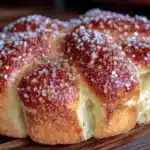
This pan de muerto is a forgiving, beginner-friendly enriched bread with a soft, pillowy texture and subtle orange flavor. It’s the perfect centerpiece for Día de Muertos celebrations, impressing even seasoned bakers with its bakery-worthy appearance.
- Prep Time: 30 minutes
- Cook Time: 25 minutes
- Total Time: 3 hours 25 minutes (including proofing)
- Yield: 2 loaves (16 servings) 1x
- Category: Bread
- Cuisine: Mexican
Ingredients
- 4 cups (500g) all-purpose flour
- 2 ¼ teaspoons (7g) active dry yeast (one packet)
- ¾ cup (180ml) whole milk, warm (110°F/43°C)
- ½ cup (100g) granulated sugar
- ½ cup (113g) unsalted butter, softened
- 3 large eggs, room temperature
- 2 tablespoons orange zest (from about 2 large oranges)
- 1 tablespoon orange blossom water
- 1 teaspoon (6g) fine sea salt
- ¼ cup (57g) melted butter (for glaze)
- ¼ cup (50g) granulated sugar (for topping)
- 1 tablespoon anise seed (optional)
Instructions
- Activate the yeast: In a small bowl, combine warm milk (¾ cup/180ml at 110°F/43°C) with 1 tablespoon of the sugar and the active dry yeast. Stir gently and let sit for 5-10 minutes until frothy and smells like warm toast. If it doesn’t foam, start over with fresh yeast.
- Mix dry ingredients: In the bowl of a stand mixer, whisk together the remaining sugar (about 7 tablespoons), all-purpose flour (4 cups/500g), and salt (1 teaspoon). Make a well in the center. If using anise seed, add it now.
- Combine wet ingredients: In a separate bowl, whisk together room-temperature eggs (3), orange zest (2 tablespoons), and orange blossom water (1 tablespoon). Add the activated yeast mixture and stir to combine.
- Form the dough: Pour the wet ingredients into the well of the dry ingredients. Using the dough hook attachment, mix on low speed until a shaggy dough forms, about 2 minutes. Scrape down the sides. Add softened butter (½ cup/113g), one tablespoon at a time, mixing on medium-low until each piece is incorporated before adding the next (about 5 minutes). The dough will look messy—that’s normal.
- Knead until smooth: Increase speed to medium and knead for 8-10 minutes. The dough should pull away from the sides, become smooth, elastic, and slightly tacky. Test by stretching a small piece—if it forms a thin, translucent ‘windowpane’ without tearing, it’s ready.
- First proof: Lightly oil a large bowl. Place the dough in the bowl, turning to coat all sides. Cover with plastic wrap or a damp kitchen towel. Let rise in a warm, draft-free place for 1.5 to 2 hours, or until doubled in size.
- Shape the loaves: Punch down the dough. Turn out onto a lightly floured surface. Divide into two equal pieces (about 500g each). Set aside a small piece from each half (about 50g) for decorative bone shapes. Shape each main piece into a smooth round ball by tucking edges underneath and rotating on the counter. Place each ball on a parchment-lined baking sheet, leaving space between them.
- Make decorative bones: Roll reserved dough pieces into long ropes about 12 inches long. Cut each rope into 4 equal pieces. Roll each piece into a smaller rope, then shape into a bone shape: make two small balls on each end with a thinner section in the middle. Place two ‘bones’ on top of each loaf in an X shape. Press gently to adhere. Form a small round ball from any remaining dough and place it in the center of the X (represents the skull).
- Second proof: Cover shaped loaves loosely with plastic wrap or a towel. Let rise for 45-60 minutes until puffy and nearly doubled. They should feel springy when gently poked.
- Bake: Preheat oven to 350°F (175°C) during the last 20 minutes of the second proof. Bake loaves for 20-25 minutes, rotating pans halfway through. They should be deep golden brown on top and sound hollow when tapped on the bottom. If browning too quickly, tent loosely with foil after 15 minutes.
- Glaze and sugar: While loaves are still warm (but not hot), brush generously with melted butter. Sprinkle or roll in granulated sugar until fully coated. Let cool completely on a wire rack before serving.
Notes
For a tangzhong-style starter (optional but recommended): mix 2 tablespoons flour with ¼ cup water, cook until thick, then cool before adding to dough. This keeps the bread soft for days. For make-ahead: do the first proof overnight in the fridge (covered tightly) to improve flavor. Do not refrigerate leftover bread—store in an airtight container at room temperature for up to 3 days. Freezes well for up to 3 months.
Nutrition
- Serving Size: 1/8 of a loaf
- Calories: 320
- Sugar: 18
- Sodium: 200
- Fat: 12
- Saturated Fat: 7
- Carbohydrates: 47
- Fiber: 3
- Protein: 7
Keywords: pan de muerto, day of the dead bread, mexican sweet bread, enriched bread, orange bread, holiday bread, dia de muertos
Find it online: https://twinkletaste.com/easy-homemade-pan-de-muerto-recipe/